
CT Freshwater Report as of 10/09/2026
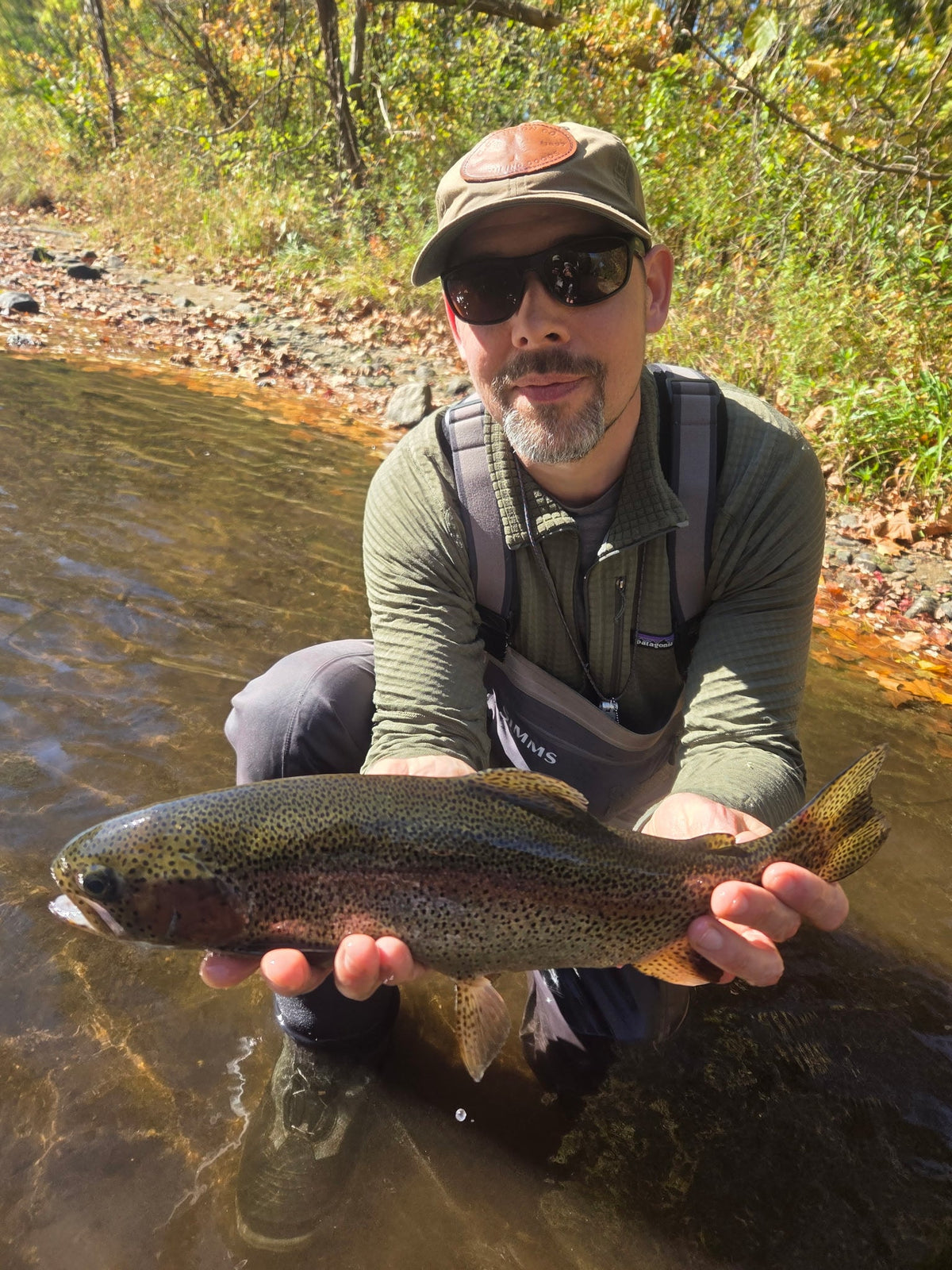
Dave Machowski's client Mike with a nice rainbow from a recent guided lesson where he caught a pile of fish! Great work guys!
REMINDER: As of September 1st, the entire river from the Goodwin Dam in Riverton to the Rt. 177 bridge in Unionville is now catch and release only.
The Farmington:
October has brought us some great fall foliage both above and below the surface. There has still been decent dry fly and nymph fishing for most anglers. We are expecting some minor rains Sunday into Monday, which may open up a brief opportunity for some streamer fishing and help boost flows slightly. Please be mindful when fishing this time of year of redds and spawning fish. I have already gotten reports of anglers seeing signs of redds across the river, and this will only continue to happen as we move further into October. Do not walk on/below redds or target actively spawning trout. Flows remain at medium-low levels. The USGS gauge in Riverton reading 157 cfs, and the Still River USGS reads 16 cfs for a combined total flow around 173 cfs through the Permanent TMA. The HOBO unit in New Hartford is still currently under maintenance, meaning all readings are currently down until further notice. We will update as soon as this changes.
Key Tip: When water temps are coming out of the dam warmer this time of year (around 61-63 degrees currently) before the reservoir flips, the river is often cooler further downstream as you get away from the dam. Cool overnight/morning temps help drop the water temperature and provide cooling, whereas temperatures in Riverton stay much warmer since the water coming from the dam is much warmer.
Current Hatches:
Throughout the day you can see sporadic small caddis of various species (#16-22), most of them being tan/brown bodied. There is also still a good number of Isonychia (#12-14) hatching as well. Many anglers have reported lots of these caddis returning in the evening to egg lay. Hebe's (#16-18), Light Cahill's (#12-14), Yellow Sally Stones (#14-18) also spring up in the evening hours. Especially on days of cooler, cloudy weather, Blue Winged Olives (#22-26) have been on the menu as well. Small olives are a common bug hatching well into the late fall on the Farmington. October Caddis have also started to show up. These large, amber orange colored caddis are quite the sight to see (#8-12). For evening fishing, a great trick is to employ flies like a cream Usual, cream Spinner, or White Wulff in larger sizes (#8-14). They work well at fooling fish in those last few moments of daylight into darkness. Spinners in various sizes (#12-26) are important to have in your box, especially in the evening when various mayfly species return to mate and fall spent on the water. Don't leave too early, as some of the best dry fly fishing is right before full darkness.
Below the Surface:
Nymphing has been slower, but still productive. In general, smaller nymphs are your best tools for success this time of year. An outlier to this is a large stonefly nymph (#8-12), which have been working well. Overall this is the time of year more generic patterns that cover lots of bases tend to be more successful than specific, hatch matching patterns. Just a handful of patterns can cover a wide subset of important bugs to imitate. Go-to's include Pheasant Tail/Frenchies #16-22, Walts Worms #16-22, and Perdigon style nymphs #18-22 in various body/bead colors. Higa's SOS in black or olive #18-20 is a current shop favorite small attractor nymph, along with #18-20 Egan's Rainbow Warrior's in pearl or black. Patterns to imitate caddis pupa are a great choice as well. A shop favorite as of late is a soft hackle hares ear, which works well at imitating caddis as well as other bugs. Some whacky patterns with attractor elements can work very well when the bite window opens up. Junk flies are worth fishing, especially egg flies. Eggs will become very important to have on your rig in the next couple weeks through the winter months.
With trout in pre-spawn and showing aggression towards each other, streamers can also be productive. I suggest trying a jig streamer in these current lower flows. They are worth trying before you leave a spot. If we do get some higher flows and stained water, chucking articulated streamers in brighter, brown trout based colors such as yellows, tans, or whites may also be effective.
Around CT
This is an excellent time of year for small streams and freestone rivers. Both native brook trout and wild browns in these rivers will mostly be in pre-spawn mode, as well as actively feeding on anything they can get their mouths on. Again, I have had anglers who prefer fishing these streams reporting sightings of redds. Do not walk on/below redds or target actively spawning trout. Fish in these systems not focused on the spawn will feed very opportunistically. Some streams may have some small hatches of various mayflies or caddis, but overall most will lack strong bug life. In these situations, prospecting with small streamer pattern can be very productive and a great way to approach these rivers. Junk flies, especially eggs, are worth fishing also. It is important to stay stealthy and try your best to approach each piece of water with a game plan so you spook less fish before you even make a cast. I strongly suggest if you're after the largest fish in the creek, focus on a small streamer pattern in various colors and cover as many likely pools as you can. I've caught some of the biggest trout in small river systems this time of year with this approach.
Warm Water
October bass have put the feed bag on. Water temps are cooling, and the Smallmouth have shifted their focus on finding the best areas to concentrate baitfish and other prey. A variety of tactics work well in the fall. In general, I find baitfish are the main attraction. On cloudy days, poppers and gurgles work well. Overall though, streamer patterns fished on an intermediate or sinking line are the play. Try various sizes and colors, and mix up your retrieve styles. Areas with structure, such as log jams, boulders, transition lines, weed edges, and drop offs adjacent to cover, are high percentage holding spots. They are often tight to structure so getting your fly as close to structure as you can and keeping it there is important. Smallmouth love to hang in pods, so if you find one you may find a pile of them together. Smallmouth often regurgitate recently eaten prey when caught, which can help you clue in to their current feeding patterns and aid in your fly selection.
Carp have put the feed bag on as fall kicks into full gear. I have been encountering many nice sized fish as of late, many of which are very fat and packing on the pounds. Sight fishing is the name of the game here, with success heavily relying on stealth and accurate presentations. You must have some sort of sight of the fish; at least enough to tell its positioning so you can accurately place your fly in front of it and "see" the take. The reward is encapsulated by a hard fought battle and a fish potentially in the 15-20lb range! We have a great selection of some specific carp flies, as well as great materials to tie some for yourself!
Have further questions or need more advice/tips before your next outing? Please feel free to call or stop by the shop! We are more than happy to help you have success on your next fishing adventure! Tightlines!
Location: 37 Greenwoods Rd, Unit 407, New Hartford, CT (4th Floor)
Phone Number: (203) 343-0775
Fall Store Hours:
Monday - Sunday: 8AM - 5PM


Leave a comment
This site is protected by hCaptcha and the hCaptcha Privacy Policy and Terms of Service apply.