
CT Freshwater Report as of 8/17/2026
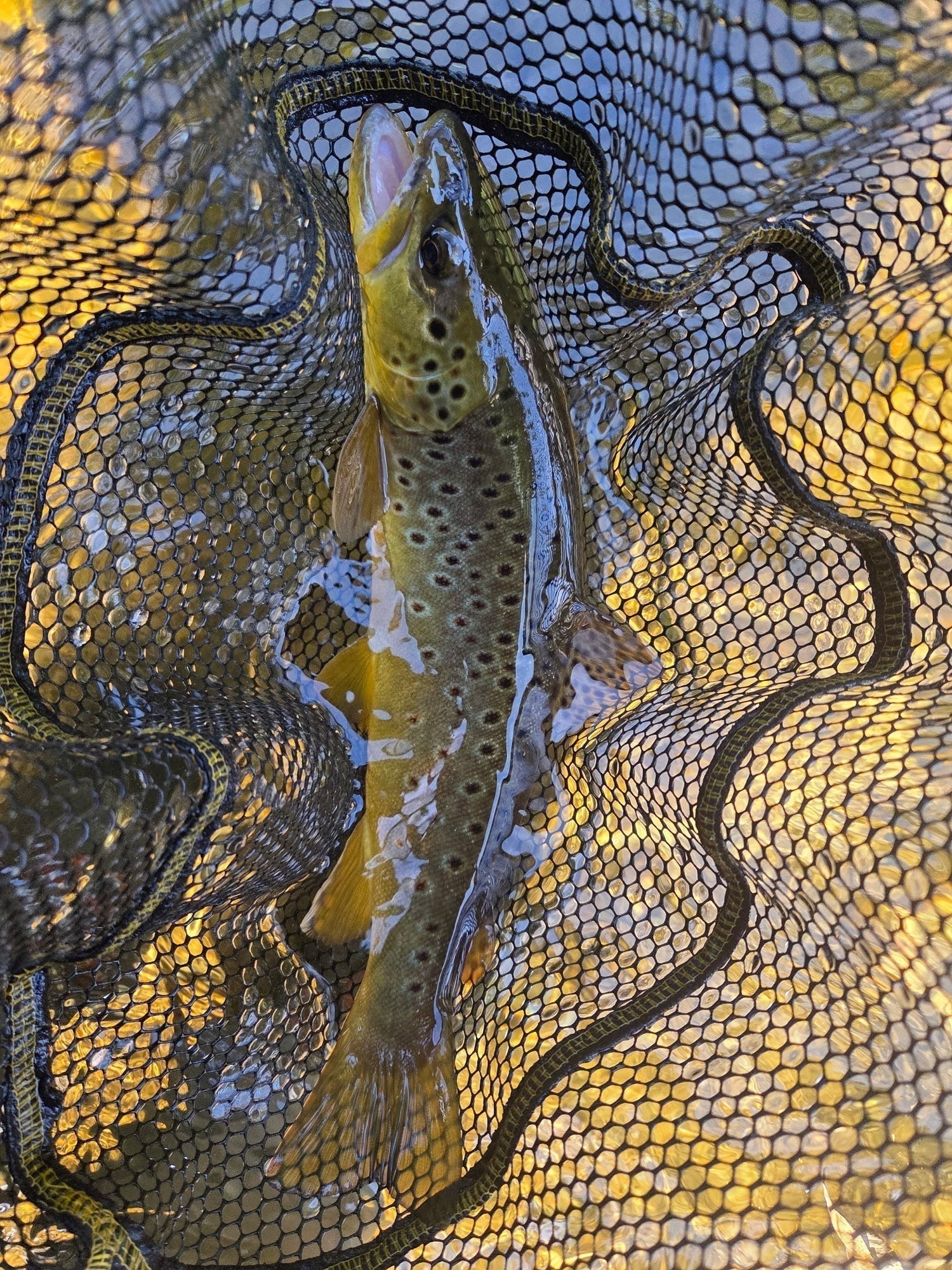
This gorgeous Farmington wild brown trout was netted by local guide Dave Machowski. One of the best sights to have in your net!
The Farmington:
Water levels and temperatures are in great shape for mid August! The dam release has been cut slightly, with the USGS gauge in Riverton reads 154 cfs, with the Still River USGS reading 18 cfs for a combined total flow of 172 cfs in the Permanent TMA. This has helped keep the river fishable through New Hartford, even in mid afternoon. It also allows for lots of diversity in fishable water; you can pick apart fast pocket water, fish pools and hunt heads, and everything in between. While less of a concern with current conditions, it is still important to keep a thermometer on you while fishing, practice taking water temperatures, and checking the HOBO unit for current water temps through New Hartford. Here is the direct link to the HOBO: LI-COR Cloud
Current Hatches:
Your best fishing is at the bookends of the day in the mornings and the evenings, especially if you are searching for dry fly fishing. Morning Trico spinner falls (#22-26) are occurring on most of the river from the confluence of the Still (Lyman's Rock) down, with the strongest currently happening in the low-mid PTMA. With Trico spinners, the key is low winds and air temperatures hovering around 65 degrees. Depending on overnight temps, this can dictate how early in the morning you need to hit the water to catch this event. From mid-morning on, Winter/Summer Caddis (#18-24) and various other Caddis (#16-22) are present. We have some great hi-vis trio spinners tied by Tom Inglis, as well as Winter/Summer Caddis adult and pupa patterns by Bruce Marino in stock and ready for your fly box. At any point throughout the day, but especially in the evenings, various other mayfly spinners of all species can be present as well. Having rusty spinners from size #10-26 will cover a lot of bases when fish are gently sipping with no apparent other hatching bugs. Throughout the day you can see sporadic Light Cahill species (#12-18), and Isonychia (#10-14). These become more prevalent into late afternoon/evening, along with Hebe's (#14-18). While Cahills/Hebe's are not sulphurs, their similarities makes your favorite sulphur patterns in a matching size a good option to imitate both. We also have some great specific bugs to imitate these hatches; a shop favorite being the Strolis Shucked Up Emerger in the Cahill variant. Flies like a cream Usual or White Wulff in larger sizes (#8-14) work well at fooling fish in those last few moments of daylight into darkness. In the afternoons/evenings or especially on cloudy/rainy days, BWO’s from a #20-24 can be present. Terrestrials, such as ants, beetles, and small hoppers are a great option as well. These tend to produce best from late morning through mid-day fished blindly through shaded areas or to sporadic rising fish. They also make great prospecting patterns used on a dry dropper setup. This is an effective tactic to employ through the summer months.
Below the Surface:
Subsurface fishing has been fairly consistent as of late, most likely due to the increase in water levels. In general, smaller nymphs are your best tools for success. Outliers to this would include a large stonefly nymph (#8-12) fished early mornings, or an Isonychia nymph (#10-14) fished in the afternoons; both in fast water. Overall this is the time of year more generic patterns that cover lots of bases tend to be more successful than specific, hatch matching patterns. Just a handful of patterns can cover a wide subset of important bugs to imitate. Go-to's include Pheasant Tail/Frenchies #16-22, Walts Worms #16-22, and Perdigon style nymphs #18-22 in various body/bead colors. Higa's SOS in black or olive #18-20 is a current shop favorite small attractor nymph, along with #18-20 Egan's Rainbow Warrior's in pearl or black. For emerging caddis, a unique pattern only available at Local Fly is BMAR's Extended Body Caddis Pupa in tan or olive, #16. This unique fly works exceptionally well fished in many different ways when caddis are present.
Around CT
The majority of small streams and freestone rivers received much needed water from the recent rains this past week. But, this hot weather makes them a day-by-day basis on fishability. In general, most are only going to be fishable in the very early morning if overnight temps are cool enough (50's-low 60's) to drop water temps into safe ranges for trout. If you can find streams with heavy spring influence, this can help keep them cooler than others. In general, these smaller freestone rivers lack strong hatches (typically) as compared to larger rivers like the Farmington. Fish in these systems tend to feed more opportunistically. If you do find a hatch, you most likely will see some sort of caddis or small mayfly, which can be matched accordingly. However, prospecting with terrestrials or attractor dries, along with small streamer patterns are very productive and a great way to approach these rivers. A dry dropper setup is also effective. It is important to stay stealthy and try your best to approach each piece of water with a game plan so you spook less fish before you even make a cast.
Warm Water
Smallmouth are a fantastic, slightly less technical option to mix up from trout. While mornings and evenings are still the best times of day to target them, they can still be caught fairly well even into the hottest parts of the day. A variety of tactics work well; from surface flies like poppers, various larger nymphs similar to those used for trout, to streamer patterns fished on an intermediate or sinking line. Mix up your retrieve styles and focus on fishing structure, such as log jams, boulders, transition lines, weed edges, and drop offs. They are often tight to structure so getting your fly as close to structure as you can and keeping it there is important. Smallmouth often regurgitate recently eaten prey when caught, which can help you clue in to their current feeding patterns and aid in your fly selection.
If you're looking for a more technical, but very rewarding large warm water fish to target, carp are a great option. The best fishing is from early morning to mid day, then again in the evening as light levels drop. Sight fishing is the name of the game here, with success heavily relying on stealth and accurate presentations. You must have some sort of sight of the fish; at least enough to tell its positioning so you can accurately place your fly in front of it. The reward is encapsulated by a hard fought battle and a fish potentially in the 15-20lb range! We have a great selection of some specific carp flies, as well as great materials to tie some for yourself!
Have further questions or need more advice/tips before your next outing? Please feel free to call or stop by the shop! We are more than happy to help you have success on your next fishing adventure! Tightlines!
Location: 37 Greenwoods Rd, Unit 407, New Hartford, CT (4th Floor)
Phone Number: (203) 343-0775
Store Hours:
Monday - Thursday 8AM – 6PM
Friday – Saturday 6:30AM – 6PM
Sunday 6:30AM – 5PM


Leave a comment
This site is protected by hCaptcha and the hCaptcha Privacy Policy and Terms of Service apply.